
Direct Marketing News: The Inconvenient Truth about Mobile Apps for B2B Sales & Marketing

DMNewsApril 14, 2014 – Byline by Gavin Finn, published by Direct Marketing News

The Inconvenient Truth about Mobile Apps for B2B Sales & Marketing

Jordan Stolper, CEO of StoryDesk, notes that, “The greatest misconception of app development is that once the software is built, the development ends.” In fact, the opposite is true. Like it or not, mobile software is an ongoing service, not a one-and-done product.” And Roy Chomko, CEO of Adage Technologies, says that, “While executives eagerly shell out thousands of dollars for an app’s development and launch, too often they fail to forecast the ongoing costs of maintaining a mobile application.” If this is true, what additional effort, time, and expense should B2B marketers anticipate?
dmnews2There are three areas of time and resource investment that every B2B sales and marketing app requires:

1. Development of the app

2. Deployment of the app to everyone who needs it

3. Maintenance and updating of the app

Examining each area will reveal not only the source of frustration for B2B app benefactors, but also a roadmap for success.

Development: A myth popular among many marketers is that developing mobile apps is cheap. Jeff Francis, cofounder and COO of SAP Business Innovation, reports that sales applications typically fall into the $50,000 to $150,000 development cost range, and can far exceed those costs if the app is highly complex with more than three mobility platforms. One study by Dr. Tim King, CTO of 5app, shows the cost of an app increasing by a factor of between 2.5 and three times when built for three supported platforms, as compared to just one.

Deployment: Simply putting an app into a store doesn’t actually deploy it to the devices of the intended users, thereby burdening developers to ensure that all required devices are supported. In the world of sales and marketing, it’s not enough to limit support only to the variety of tablets and smartphones, because many sales personnel use PCs.

Maintenance: In many ways a B2B mobile app is similar to an automobile. Once the product has been paid for, you must “feed” and maintain it—gas, oil changes, brakes, etc. Depending on development, it will require updates whenever operating systems are updated or released, new device types and sizes become available, and even when new versions of Web browsers are released. In 2013 alone, iOS and Android operating systems had dozens of upgrades and bug fixes, requiring apps to be modified just to keep them working.

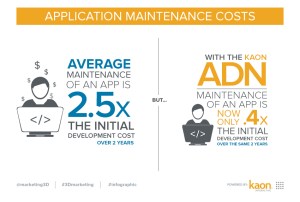
Experience shows maintenance costs far outweigh the initial cost of building the app. Forrester Research has documented that the 2-year maintenance cost of a B2B app is 2.5 times the initial development cost. Estimates by MGI Research show apps will require at least four major updates stemming from operating system and device updates over an 18- to 24-month period for just oneoperating system platform (e.g. iOS.)

Here are a few things to keep in mind during the app development process:

Finding a cost-effective solution: Achieving all of the benefits of having a B2B app deployed to marketing, sales, channels, and customers, while at the same time being able to afford the development, distribution and maintenance costs, can be a challenge. For example, Kaon developed its own “Application Delivery Network” to help reduce the costs associating with distributing and maintaining mobile apps.

True interactivity: The vast majority of B2B sales and marketing apps are tablet-based versions of slide presentations, videos, and brochures. These are not going to be more effective simply because they are used on a touchscreen device. Consider the user experience: engagement with the end user on a sensory level; creating an emotional connection; and providing useful, relevant information.

“Mobile first” does not mean “mobile only:” Consider that your app needs to be delivered not just to tablets and smartphones, but also as standalone applications to PCs (laptops/desktops, Windows, Macs, Linux and Chromebooks) and as a browser app running on the Web.

Online and offline: Sales and marketing teams often encounter customer-facing venues where Internet is limited or simply not available. Applications that are fully functional offline without connectivity to the Web will be more useful to your audience.

Bundling to reduce costs: By combining distribution and maintenance fees, and performing updates at the platform level, you can dramatically reduces the lifetime costs of B2B app—from an industry average of 2.5 times the development cost over two years to less than 20% of the average development cost per year.

B2B apps for sales and marketing have already proven to improve sales effectiveness and marketing efficiency. Creating transparency around the entire process will dramatically improve the likelihood of sustained success.
Posted in CEO Corner | Tagged , , , , , , , , , , , , , | 2 Comments

Kaon’s Digital Platform Gets Kudos from ‘Mobile Marketing Watch’

In the vastly competitive modern world of digital marketing, it’s difficult to earn the reputation of pioneer and venture into new, previously uncharted waters. But that’s what the folks at Kaon Interactive have done with their latest efforts, about which Mobile Marketing Watch was briefed last week.

A provider of interactive 3D product marketing applications, Kaon has launched the world’s “only cloud-based digital marketing platform” that enables B2B marketing and sales enablement applications to be created once and delivered anywhere, at any time, and on any device, without re-development fees.

In a nutshell, the company says, the new Kaon Application Delivery Network (ADN) eliminates the hidden costs of re-creating and maintaining interactive 3D product applications on multiple platforms, ensuring that these engaging experiences ALWAYS work and are delivered into the hands of prospects, customers, sales teams, channel partners and marketing professionals, regardless of their geography or device.

Industry research has shown that the development costs for a typical B2B interactive mobile application is between $50,000 and $250,000, depending on the complexity of the application, and costs increase 3x when supporting up to three devices. Less obvious is the required maintenance expense of a B2B application, which averages 2.5x the initial development cost, over a two-year period.

“While many marketers often budget for the initial development of the application, they often don’t consider the hidden costs associated with maintenance due to platform/browser and operating system upgrades and bug fixes,” explains Gavin Finn, CEO of Kaon Interactive.

“In 2013 alone,” Finn continues in a provided statement, “there were dozens of upgrades and bug fixes to iOS and Android operating systems, impacting many B2B applications. This is one of the reasons that 25% of B2B business apps are deleted after their first use, and that after only 90 days just 35% of the typical B2B app’s users are still active. The Kaon ADN is not only changing the way interactive product content can be used (by anyone, at anytime and always up to date) but it also ensures that the initial marketing investment is leveraged across operating system platforms, without additional fees to support incremental operating system updates or bug fixes.”

ADN_InfoGraphic_1

Posted in News | Tagged , , , , , , , , , , , , , , , | Leave a comment

Why “Interactive” is not Synonymous with “Online”

A product manager was presenting his product’s features to a group of prospective clients at a live event, when his presentation suddenly froze on the large screen behind him. He apologized, saying “I’m so sorry, this interactive presentation seems to have lost WiFi connectivity. Please bear with me.” Slowly, his audience drifted away, while he attempted to restart the presentation, or re-connect to the web. Sadly, by the time he had his web demo back online, the prospects had dispersed.

While it’s a shame that his presentation had technical difficulties, his reference to the type of demo as “interactive” was interesting. All he was doing was going through a series of HTML pages, with some images and a text-based explanation of the product. What’s interactive about that?

This product manager’s use of the term “interactive” in reference to online applications or content is all too common. But it is actually a significant problem for B2B marketers.

Just because something is online does not mean that it is interactive. Similarly, an interactive experience does not have to be online.

Just broadcasting or presenting product features or marketing messages to an audience is highly inefficient, and actually results in misalignments in expectations and perceptions. Watching a video is not interactive. Even when the video is online. It’s a fundamentally passive process. An application that delivers relevant information (preferably visually, as well as using text) based on an individual’s specific input and responses during the “conversation” is an example of interactivity.

When B2B marketers think of engaging with their target segments, they should be thinking about a wide variety of interactive experiences, both online and offline. Why? Because interactivity is the best way to ensure that prospects and customers remember important information. When people engage interactively, their knowledge retention increases by a factor of three!

True interactivity is the process of engaging in a dialogue involving three primary dimensions:

1. Sensory experience: using any combination of touch, visual, audio, smell, and taste;

2. Emotional experience: developing an emotional response or connection to the experience, and

3. Intellectual experience: the exchange of information that is relevant and useful.

When an experience involves these three aspects of connection and communication, true interactivity has taken place. Interactivity is non-linear, meaning that specific responses are provided based on individual actions, resulting in a meaningful exchange of ideas and information. The user does not have to follow a prescribed sequence of events; rather, they create their own personalized path by exploring areas of interest to them, at whatever degree of detail is relevant.

For B2B marketers and salespeople, the goal should be to turn every encounter with a prospect or client into an opportunity for an interactive experience. Rather than use the iPad as a sales presentation device, for example, deliver the app to the prospect directly. When a user is engaged as they explore the iPad app that teaches them about how a new product can be used to solve an important problem, then there is an interactive path of dialogue and knowledge transfer – sensory, emotional, and intellectual experiences driving results.

Posted in CEO Corner | Tagged , , , , , , , , , | Leave a comment