The Unified Business Model (The Future of Sales & Marketing)

Here it is, the last post about my INBOUND 2015 experience. Hope you learned something from my series of posts.

Hubspot Inbound Conference Recap 9 of 9

The Unified Business Model (The Future of Sales & Marketing) by Oliver Lopez from Structsales.


80% of leads converted are never turned into sales.

salesandmarketing

What is the unified business model?

  • One organization (Sales and marketing working together)
  • One process
  • One set of highly relevant KPIs

Cold calling should be enhanced by a strong collaboration with marketing so both marketing and sales proactively produce significant amounts of new business. Your MQLs (marketing qualified leads) and your SQLs (sales qualified leads) need to be clearly defined within the organization to avoid conflict. Marketing should be nurturing based on what the contacts have done before, i.e. downloaded white papers, visited a specific page of your site.  Focus your attention on existing leads who are not yet ready to buy and those who you’ve lost before.

Your CLOSERS (Sales managers or VPs) should ignore leads who are not able to buy (Nurture them or they should go to inside sales).

Once you meet with a customer, stop all forms of communication that are normally distributed to new prospects to make them aware of your company.

That’s a wrap! Three long days of sessions and presentations bundled up in short descriptions.  Overall, my experience at INBOUND 2015 was awesome and inspirational. I learned a great deal of information and hope you did too from reading my posts!

Posted in Marketing Guru | Tagged , , , , , , , , , | Leave a comment

How to Measure Your Social Media Activities Using Google Analytics

Hubspot Inbound Conference Recap 8 of 9

How to Measure Your Social Media Activities Using Google Analytics by Michael Stelzner of Social Media Examiner.

Number one challenge all google-analytics-examplesocial media users face is measuring.

Utilize Google Analytics to see what is coming through social media and how much traffic is coming from activities vs organic. Set goals for your social media on Google Analytics so you can see if your actions are improving or declining efforts.

Specifically use the Google UTM (Urchin Tracking Monitor) tracking to spot trends, test keywords and articles, understand how your efforts contribute to traffic and goals, and prove your investment in time and effort is returning something.

Your social teams should be reviewing all social media channels month by month to understand where they should be spending their time. They should also set goals within the tools so they can determine whether their actions are improving the sites or resulting in a decline.

Key takeaway: Use Google Analytics to determine trends, patterns, and accomplish goals throughout your social media accounts. 

p-analyticsKaon Interactive offers powerful analytics for tracking and measuring all aspects of user engagement within our applications, delivering real insight into the effectiveness of 3D Product Models and interactive storytelling applications.

Posted in Marketing Guru | Tagged , , , , , , , , , , , , , | Leave a comment

Power the Bottom of the Funnel with Sales Enablement

Hubspot Inbound Conference Recap 7 of 9

Power the Bottom of the Funnel with Sales Enablement, Deborah Farese, Hubspot.

First and foremost, you need to understand your buyer persona, i.e. name, demographics, goals, habits, and needs.

This will give you a sense of how you should talk to your prospect.

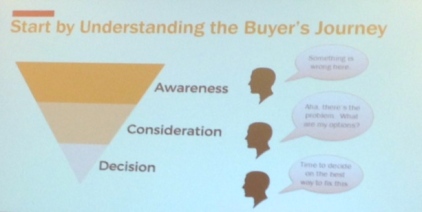
Then, you need to focus on the buyer’s journey. Many studies show that 2/3 of a buyers research is completed before even reaching out to sales. Therefore, you need to start thinking of the buyers journey:

  • Awareness- when a IMG_6699person realizes there is something wrong
  • Consideration- Here is my problem and the goal I would like to achieve
  • Decision- Time to decide what is the best way to fix my problem and reach my goal

Here are 6 tips to help your company power the bottom of the funnel with sales enablement:

  1. Prioritize leads and help leverage triggering events
    1. A triggering event surfaces pain
  2. Lead with customer pain points in your pitch deck
    1. Give buyers something they can relate too
    2. Be different, connect with the people you are selling too
    3. Show them what you are doing that can help them overcome their pain
  3. Create a diagnostic checklist for reps to use in exploratory meetings
    1. Create a guide for reps to use to surface a prospects pain point
      1. Show them the pain that they may not even know they have
    2. Do research on your prospect’s company and website to see where they can improve
  4. Optimize the Bottom of the Funnel (BOFU) offers for keywords comparison shoppers use
    1. 78% of business software buyers begin their evaluation with a web search
  5. Monitor social media for conservations with buyers
    1. 1 in 3 US buyers are influenced by social media in their purchases
    2. Look where your buyers are creating conversations on forums
      1. Monitor buyers activity and you can learn a lot from their actions
  6. Develop a community of customer advocates to help tell your story for you
    1. Customers are key in your BOFU (bottom of the funnel) for referrals, references, case studies, product reviews, and social media responses
    2. Your customers are your biggest advocates

Overall, understand that a buyer’s journey has began long before they reach out to a sales rep. Don’t tell them information they already know, feed them new insights and pain points.

Kaon Interactive can help assess and alleviate the pains of large or complex equipment manufacturers by creating 3D Products Models or interactive stories on all devices and the web. Check us out!

Posted in Marketing Guru | Tagged , , , , , , , , , , , , | Leave a comment