
 When a big part of your business is making 3D product representations available to as many people as possible, you pay particular attention to technologies that might help you achieve that goal. WebGL is a promising new technology that can bring 3D rendering into the browser as a native feature. And if you follow the hype, you might think it was already widely deployed.
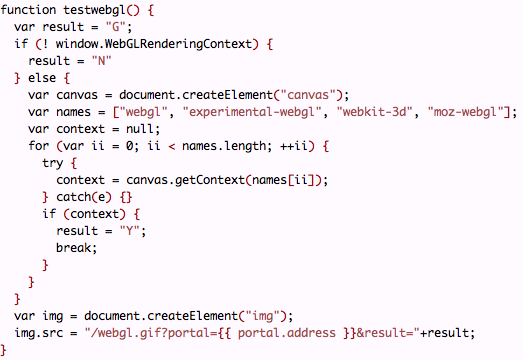 However, uptake among web consumers does not necessarily predict availability in the enterprise. To figure out whether WebGL is an option for our B2B customers to deliver their sales and marketing messages to enterprise users, we instrumented the login page of our content download portal. Over the course of a month, we tested WebGL availability for 1,872 visitors’ machines.
Most of the people coming to our content portals are field sales and marketing teams, and channel partners, for large high-tech companies. Over the sample period, most of the visitors were from companies that sell computer networking, hardware, and infrastructure products. Of all the enterprise users, you would expect that these are the most likely to have access to cutting-edge technology.
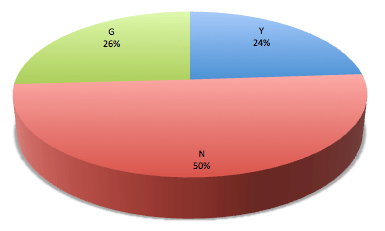
To cut to the chase, the portion of these users with availability of WebGL support in browsers is just 24%. (If you only consider those with hardware-accelerated 3D, the number would be more like 19%; I’ll explain this below.)
We classified users into 3 groups:
- (Y) Those who have a browser with WebGL available (24%)
- (G) Those with a browser that supports WebGL, but it is disabled (often because they have a graphics card that cannot support WebGL) (26%)
- (N) Those with a browser that has no idea what WebGL is (50%)
Our data shows that Chrome users are pretty much all up-to-date, which is very significant because the current version (18) of Chrome includes a software rendering solution for WebGL. That means that people who would not have been able to view WebGL in version 17 of Chrome (“G”s) now can (making them “Y”s).
Since Firefox includes no such software pipeline, we can guess the number of Windows users who have hardware that does not support WebGL, even though their browser does. It turns out that is a whopping 57% (115 Firefox “Y”s, vs 147 firefox “G”s). This tells us three things:
- Most enterprise users do not have up-to-date 3D accelerators in their Windows computers
- The addition of a software engine is a critical feature for success in the enterprise
- Enterprise WebGL apps should be tested and optimized for software rendering, because a majority of users will see that version
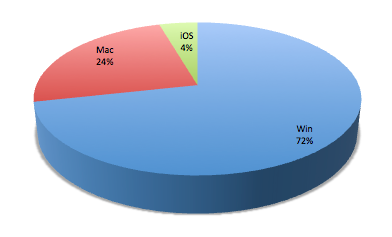 Digging into the data a little deeper, we see that Apple has a pretty impressive foothold these days. In our sample, 24% of users were on Mac, and 4% of users were on iOS, leaving just 72% of users on Windows. We do not know whether this reflects more adoption of Apple as enterprise hardware, or is just reflective of field sales forces using the best computer for their needs, regardless of what the IT department prefers they use.
While pretty much every Apple computer and tablet has 3D acceleration hardware built-in, it turns out this doesn’t bolster WebGL’s number much. The problem is that the default browser for both Mac OS X and iOS is Safari. Safari knows what WebGL is, but it has it turned off. So 61% of Mac users are “G”s, which could become “Y”s if they just knew what hidden box to check.
 If we look at the breakdown of people who have a WebGL browser, we see that, across operating systems, 54% of those users are on Chrome, and 46% are on Firefox.
 If we look at the breakdown of people who cannot use WebGL, we see that, across operating systems, 60% are using IE (which has no WebGL support at all,
 nor plans to add it [Update: see below]), 25% are using Safari (on Mac and iOS), and 13% are on Firefox. Only 1% are on Chrome, and they’ll move into the “Y” camp as soon as they get up-to-date.
So what has to happen for WebGL to become a viable enterprise option? The quickest path would be IE adding WebGL support, but that seems very unlikely to happen. [Update: see below.]
Firefox has a stronger presence in the enterprise than chrome (which is a little surprising, actually). So getting a software rendering solution into Firefox would be a big help.
Apple can change the default for Safari from “Disabled” to “Enabled” with a tiny software update. That would bring in just about all the Mac users. Enabling WebGL in the version of Safari for iOS would bring in those users, as well.
Together, a software renderer in Firefox plus Apple fully embracing WebGL would bring support to 55% of our enterprise users. That leaves just 45% of users on Internet Explorer, with no WebGL in sight. Is 55% coverage good enough? No, not for Kaon it isn’t.
My conclusion is that while WebGL is very cool, Microsoft’s refusal to support it will kill it as a web technology in the enterprise. [See update, below]
This does not mean WebGL has no place in the enterprise, of course. People have to install special software to run enterprise applications all the time, and by installing Chrome, they could get access to this new technology. But if you are designing web content that you want enterprise users to see in the browser they are using today, then WebGL is not a viable option, and there does not appear to be any way it will become viable in the foreseeable future.
Update: July 30, 2013
After stating categorically that they will never implement WebGL, Microsoft surprised everyone by not only deciding to include WebGL in version 11 of IE, but to back port IE11 to Windows 7, and to provide a software rendering option for people without a trusted hardware pipeline. This is huge. Judging by visits to the kaon.com web site, it looks like only 20% of enterprises are still at Windows XP. That means that more than 80% of Windows users are on a version of the OS that supports IE11. Furthermore, MS has shifted to a forced-update approach for the browser, which means that provided you are not still on XP, then you will almost certainly be running IE11 shortly after it is released.
It is hard to predict timing, since MS is being cagey about exactly when IE11 will move to general release. However, it is looking like sometime in 2014, WebGL may reach critical mass in the enterprise.


 Kaon Interactive