We now live in a moment of profound change. In just the last 50 years, the average life span of a company on the S&P 500 has fallen from 75 years to 15 years. The common thread? Thriving companies have rapidly adopted a digital engagement strategy across their entire customer lifecycle.
In fact, we are emerging as a digital engagement economy. This shift has rapidly evolved from offline to websites, to smartphones, to tablets, to kiosks and large touch screens, to social media, and leading to interactive experiences everywhere. And next, we are about to be driven by immersive experiences.
While many marketers see these changes as incremental; requiring only minor tactical adjustments, the truth is that succeeding in B2B marketing depends on how well and how rapidly companies understand the systemic changes that are now imperative in engaging prospects and retaining customers.
Many of the necessary underlying marketing technologies are being adopted in the B2C world, but these immersive consumer experiences are creating a set of expectations that translate directly into our business lives.
The marketing challenge of a new generation
Most B2B companies are selling change. This is particularly true of companies that provide complex solutions and products, in a wide variety of industries. The proposed new products and solutions are merely mechanisms that their customers would use to achieve their business and technical objectives, which (by definition) will involve changing from what they are doing today to something different… and better.
The difficulty marketers are facing is that people tend to suffer from what cognitive scientists and behavioral economists call ‘loss aversion’. That is, they tend (even subconsciously) to avoid a possible loss by sticking to the status quo, rather than risk a possible gain by opting for change. This is particularly true in large organizations that may be highly risk averse. (Upton Sinclair, an early 20th century American novelist noted: “It is difficult to get a man to understand something, when his salary depends upon his not understanding it.”)
To combat this loss aversion, we must demonstrate that the changing world will create big winners and big losers in our prospects’ specific competitive markets. The marketer’s responsibility is to show both that companies are likely to achieve greater success by adopting these solutions and products, and also that not doing so will likely result in an unacceptably negative future for the prospect.
The more complex the solutions and products, the more difficult it is to explain (particularly just with words) how the customer’s world will be different and better. This means we have to innovate in how we deliver our value stories, and demonstrate the outcomes that our products and solutions will deliver. B2B marketers can now use two different kinds of immersive technologies: augmented reality (AR) and virtual reality (VR) to help extend the effectiveness in delivering their value stories.
Augmented reality
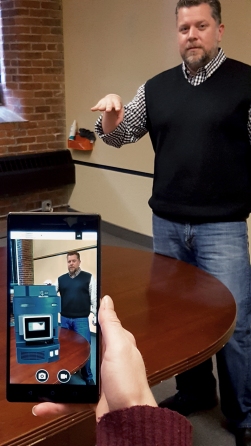
Augmented reality is the ability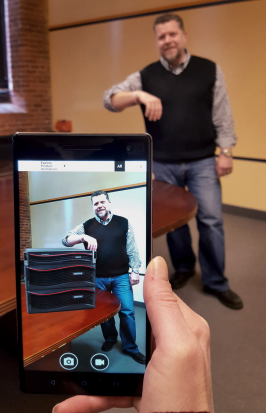 to take a real-time camera view of a physical space (say, from a mobile/tablet device) and superimpose digital objects within that space virtually. In true AR, the digital object fits perfectly into the physical world because the product is scaled correctly and it knows where it is in the spatial layout of the camera view.
There are, of course, different kinds of AR applications, including some very popular consumer games (such as Pokémon Go.) Other applications show images of consumer products based on a specific GPS location, or present data that represents some meaningful information based on what the person is seeing through the camera view.
A critical component for successful marketing of AR is to develop an emotional connection during the customer engagement. When customers are using an AR application, their surprise, delight, and wonderment form lasting memories and impressions, as they develop an understanding of how innovative the experience is. Without even realizing how much they are learning about the solution, they absorb a great deal of useful information because they are so emotionally connected to the experience itself.
Augmented reality has the power to personalize the B2B marketing (and sales) experience in a profoundly impactful way – by allowing the customer to understand exactly how your solution fits into their world.
Virtual reality
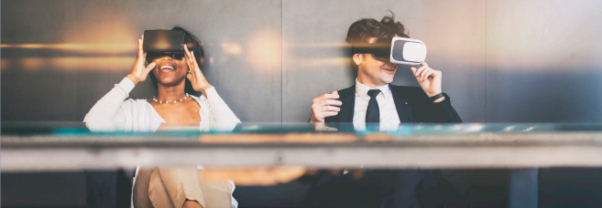
Virtual reality is the ability to place a person inside a virtual space, allowing them to move around and interact with that space as if it were the real, physical world. The key here, however, is we have to immerse the user in that digital world. That is why VR experiences include the use of a headset, which blocks out any view of the physical world, and creates a fully immersive experience.
Inside these immersive experiences users can enter a 360-degree environment and move through the space at their own pace, explore things of interest to them, and develop a uniquely personal journey.
While the VR experience is intrinsically exciting and interesting, in order for it to be effective as a B2B marketing tool, it should deliver all three dimensions of engagement – intellectual (some useful and relevant knowledge about the solution or products,) sensory (seeing and/or hearing relevant aspects of the environment that resonate with their own work environment,) and emotional (creating a sense of connection with the environment and the solutions).
The impact of a fully immersive VR experience is immensely powerful, transforming the prospect from a viewer/listener to an active, integral participant in a resonant narrative. Their individual experience develops both a real understanding of the value message and a unique relationship to the way that the value story unfolds. These memorable experiences lead to much deeper connections than can be achieved using more passive marketing strategies.
AR and VR are facilitating immersive experiences for B2B marketers by amplifying their customers’ receptiveness to key value propositions across the entire customer lifecycle. These experiences result in a greater emotional connection with the products, creating a transformative effect on the customer that will help demonstrate the products value within every business setting. There is no greater accomplishment in marketing.

 s.
s. 





 Kaon Interactive