Diving into Digital Transformation

Bio-Rad Laboratories, Cisco, Micron Technology, PHC Biomedical, Siemens Industry, Thermo Fisher Scientific Share Their Stories of Success at Kaon’s Regional Seminars

Crossing state and industry lines, marketing and sales leaders from companies in the life sciences/biotechnology, industrial, and information technology fields shared the challenges, best practices, and results of their unique digital transformation journeys, during three regional Kaon Marketing Innovation Seminars, titled “A Road Map to Digital Transformation Success.” The common thread between them all is how groundbreaking and impactful these processes have been for their teams, their companies, and their customers.

Industry leading speakers at the seminars included:

  • Sarilyn Johnson-Carter, Director of Sales at Bio-Rad Laboratories
  • Spandana Lakkaramju, Global Digital Marketing Manager at Cisco
  • Morgan Pearson, Senior Manager of Marketing Operations at Thermo Fisher Scientific
  • Carl Radosevich, Head of Corporate Planning, Manager of Product & Business Intelligence at PHC Biomedical (formally Panasonic Healthcare)
  • Heather Rickart, Head of Communications at Siemens Industry
  • Tim Silk, Senior Manager, Systems Engineering, Data Center Technologies, U.S. Public Sector at Cisco
  • Matt Wokas, Sales Enablement Manager at Micron Technology

Defining Digital Transformation

So, exactly what does digital transformation mean? Digital transformation is the use of digital technology to solve traditional problems. These digital solutions enable new types of innovation and creativity, driving business outcomes and change, rather than simply enhancing and supporting traditional methods.

Every organization must create their own unique roadmap for digital transformation to overcome their specific business challenges and achieve corporate goals.

Morgan Pearson from Thermo Fisher Scientific and Tim Silk from Cisco explain their definitions in this short video from the Boston seminar.

Creating Snackable Content

Heather Rickart, Head of Communications at Siemens Industry, at the seminar in Chicago, defined digital transformation as the transition to “snackable, personalized content”, similar to social media, that finds buyers at the right time along their journey with the right message. Siemens’ transition to creating, deploying and adopting an interactive application initiated and propelled this transformation for them.

Until recently, Heather described Siemens as an old-school organization, relying on very traditional forms of printed marketing communication, with which their existing sales force was very comfortable. However, as their workforce is shifting and they are recruiting talent straight out of universities, they realized they needed to catch up and present themselves more innovatively.

Siemens Industry Application Demo at Kaon Marketing Innovation Seminar in Lincolnshire / Chicago 2019
The Siemens application, created to align with “The Challenger Sale” methodology, focuses on 10 vertical markets and horizontal segments (automation, fire, security, IOT, smart spaces) and is being used as a sales tool and at trade shows. It empowers 900+ global sales people to walk customers through data center content and to talk clearly and consistently about why Siemens is the expert, what the best practices are, and which Siemens solutions will solve the customer’s unique problem. Further through the buying cycle, the sales reps refer to the application and share links with their customers; it provides them with an easy touch point.

Returning to the concept of snackable content, Heather shared how the application content creation process forced them to pare down, making content that is concise, relevant and meaningful. It now is much more effective and accessible.


From Product Sellers to Interactive Storytellers
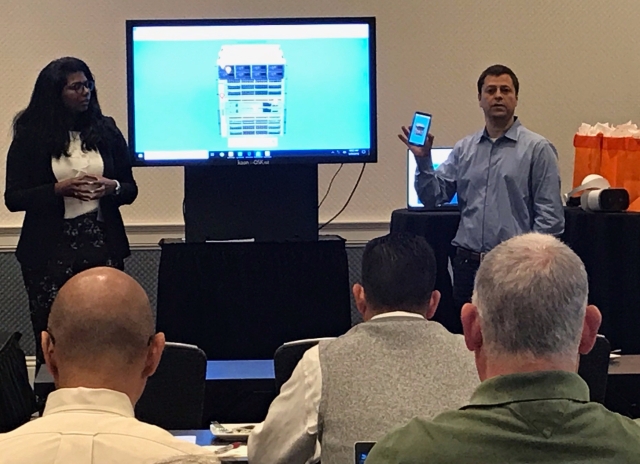
Cisco Application Demo at Kaon Marketing Innovation Seminar in Santa Clara 2019
At the seminar in Santa Clara, Spandana Lakkaramju, Global Digital Marketing Manager at Cisco, demonstrated their CX Product and Services Catalog application – a virtual, fully interactive, 3D catalog containing every piece of hardware Cisco sells. As a long-standing customer, Cisco has continually found value in this application because it truly transformed the way that their sales team communicates, by giving them access to their virtual products EVERYWHERE, online or offline, regardless of device, geography, or venue.

From 3D product tours embedded into their website to augmented reality displays at Cisco Live, this application enables Cisco’s employees and customers to access photo-realistic, to-scale product models, with relevant product value messaging, anytime and anywhere. The application also includes several interactive stories that walk users through some of Cisco’s more complex, ethereal service products.

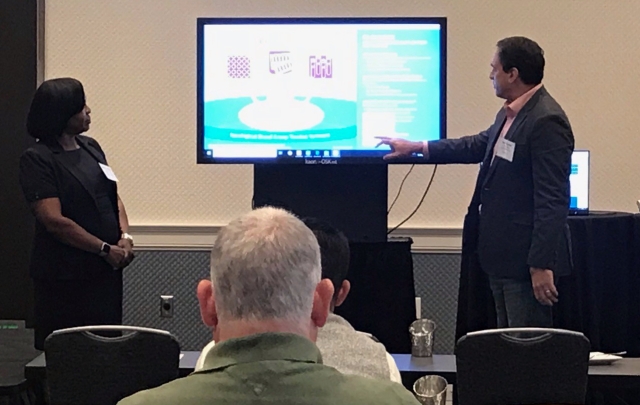
In Boston, Tim Silk, Senior Manager, Systems Engineering, Data Center Technologies, U.S. Public Sector at Cisco, demonstrated a new storytelling addition to the Cisco application, which has empowered their sales team in effectively telling their multi-cloud story. Cisco Multicloud Demo at Kaon Marketing Innovation Seminar in Waltham / Boston 2019
This “Multicloud World” application communicates an intangible, complex concept in a way that is visually simplifying and engaging so that customers can understand and retain the value of Cisco’s cloud solution.

Micron Technology, a provider of OEM memory solutions, needed an interactive application to change the conversations their sales reps were having, focusing them on value-based discussions instead of price. “Our products are, literally, everywhere, and we really needed a way to show how our technology makes everyday life possible,” explained Matt Wokas, Sales Enablement Manager, during the Santa Clara seminar.

Kaon developed “The Storage Revolution” application that sets the stage of what is changing in the storage industry and why Micron’s solutions are so important. The three-tier layout, focusing on “drive changedeliver value, and make it possible,” allows them to tell their story and extrapolate the conversation with other parts of the business to talk in a broader way about a commoditized product.

The application is used on touch screens at trade shows to start conversations and generate leads; on tablets, smartphones, and laptops by the Micron sales force; and on Micron’s website – increasing session duration, lead qualification, and conversion rates.


Moving Biotechnology Buyers from Awareness to Decision-Making Faster

Perhaps no solution story is more complex or has a more potent impact than the inner workings of a laboratory. A cluster of intricate instruments and highly customized workflows all need to work harmoniously in a small space. Oddly enough, many of the products in modern-day labs have become commoditized, leaving competing marketers scrambling for differentiation points that set them apart.

Thermo Fisher Scientific already had realized the power of digital transformation on marketing and sales and are well into their journey. The marketing team elevated it to the next level when they introduced their digital lab design tool. They went from an antiquated, but common, analog way of laying out a lab using Post-It notes on graph paper to a fully digital, interactive, personalized, and precise laboratory design tool.

Thermo Fisher Scientific Lab Design Tool Demo at Kaon Marketing Innovation Seminar in Waltham / Boston 2019
Morgan Pearson, Senior Manager of Marketing Operations at Thermo Fisher Scientific, demonstrated how this application enables Thermo Fisher Scientific sales reps to digitally lay out the customer’s lab, to precise scale, in customer meetings with all of their current furniture and instruments (including windows, doors, desks and accessories) and then insert Thermo Fisher Scientific products to see how they will fit and function in their actual laboratory space. Moreover, the customer can then experience their newly created digital lab in augmented reality (either life-size or on a tabletop) or virtual reality, creating an incredible and unparalleled emotional connection for the buyer.

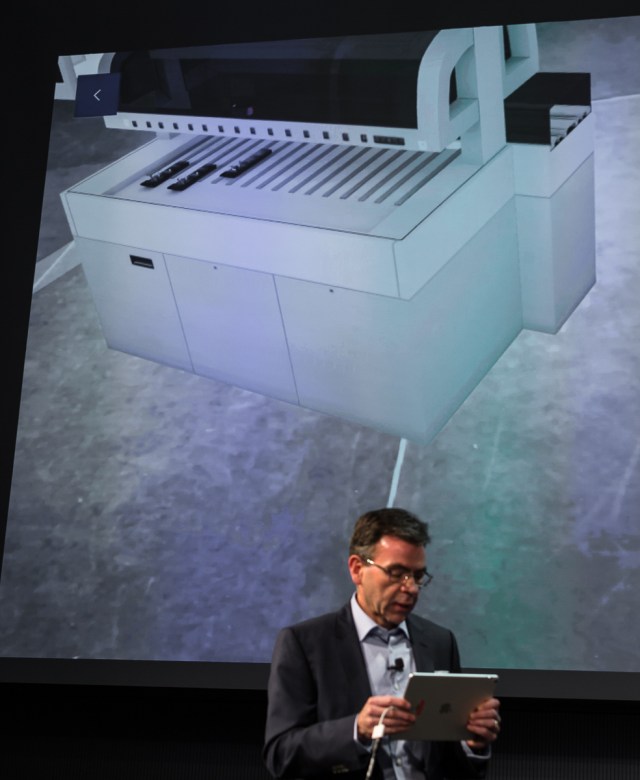
Bio-Rad Laboratories Augmented Reality (AR) Demo at Kaon Marketing Innovation Seminar in Santa Clara 2019
Bio-Rad Laboratories also has harnessed the power of augmented reality (AR) to show how their products fit within a customer’s space, giving customers the ability to see and manipulate the products through photo-realistic, animated, 3D product models in a way they never could with physical products.
Bio-Rad Laboratories Application Demo at Kaon Regional Seminar in Santa Clara 2019Demonstrating the application in Santa Clara, Sarilyn Johnson-Carter, Director of Sales at Bio-Rad, said that with AR, the conversation with the customer goes from “why” would they want our product to “where” should they put it. She stressed that these interactive and innovative applications completely shift the conversation with the customer, leading them through the buyer’s journey faster and more effectively.

PHC Biomedical (PHCbi) was facing a huge logistical challenge of shipping hardware all over the world, and in the case of some of the larger lab equipment, it was almost impossible to transport. They found the perfect solution with photo-realistic, virtual, 3D product tours that enabled customers to interact, explore, and uncover product features, functions, and value differentiation messaging. Running on Kaon’s platform, PHCbi also had access to their 3D product models in AR, which allowed them to virtually show products within their trade show booth, at scale, without actually having their physical products present.

PHCbi Application Demo at Kaon Regional Seminar in Lincolnshire / Chicago 2019
Now, as Carl Radosevich demonstrated in Chicago, PHCbi marketers can “virtually” bring their products to hundreds of small, niche trade shows and university events. The product marketing team says the application is “super valuable” as a way to provide virtual, hands-on training for the global sales teams and educate them about the equipment.

With the ability to share links with customers directly to these 3D products from the application, the application itself has become PHCbi’s collateral in the form of a modern, virtual handout to leave with customers and sales reps. Thoroughly embracing the digital transformation concept, the marketing team uses the application anywhere and everywhere traditional collateral would be: website, email blasts, fact sheets, brochures. It becomes a more innovative and reliable guide, with built-in metrics behind it, that the team can feel confident in given that 70-90 percent of their buyers’ decisions are made prior to talking to a sales rep.


Road Mapping Your Digital Transformation

It is interesting to note the commonalities among the challenges that prompt digital transformation across these different industries: a need to appear innovative and modern, a lack of consistent value message across global organizations, difficulties in demonstrating large and/or delicate products, and complex solution stories that sales and customers struggle to understand. Taking up the digital transformation torch can be risky and intimidating (real change always is), but each of these marketers has proven that it is both necessary and worthwhile to achieving success.

To learn more, please visit www.kaon.com.
Posted in 3D Products, Marketing Guru, News, Sales Tools, Trade Show Trends | Tagged , , , , , , , , , , , , , , , , , , , | 1 Comment

How Marketers Can Bridge Innovation and Business

This article was originally published by Chief Executive, “Kaon Interactive CEO on Bridging Innovation and Business,” January 18, 2019.

Kaon Interactive CEO and President Gavin Finn is all about bridging the gap from technological innovation to the marketing and business side. When he joined Kaon Interactive in 2005, it was still very much a technology-focused orientation.

“My focus has been on thinking about how marketing and sales can benefit from innovations and behavior to really meet the needs of the way that the world is evolving in general,” Finn says.

Kaon AR with Gavin Finn

He has done this on some level throughout his career, both at small companies and multinationals alike. At Kaon, Finn’s goal is to take the company’s augmented and virtual reality marketing and sales applications and make them usable for customers. “It’s a pervasive challenge for enterprises to convey their complex products and solution messaging to a variety of customers within their buying ecosystems.”

Finn says augmented and virtual reality technologies can help their customers tell “very complicated solution stories and messaging.” They can help immerse someone into an environment where they can actually see what these complex marketing and messages mean, rather than imagining it.

Chief Executive talked with Finn about the challenges of using a newer concept to market and sell products, how he recruits tech talent and more. Below are excerpts from this conversation.

What are some of the big challenges that you guys face in trying to kick-start a newer concept in terms of being able to market and sell products?

I think CEOs in particular are always interested in looking at creating long-term competitive differentiated value that allows them to create a sustained, competitive advantage. And so, what we have to do is we have to find ways of linking those key strategic goals that CEOs have for marketing innovations. And so, in using marketing innovations, we can help accomplish these strategic objectives.

So, some of the challenges that we have is very often, marketers are focused on very tactical objectives that are focused on an event, a customer event or a trade show, or a product launch, or some bounded marketing objective. One of the big challenges is to help marketers align their key initiatives and all of the deliverables with the senior executive strategic objectives. Because when you think about it, all of these kinds of technologies can be viewed as sort of technology for technology’s sake by the CEOs and CFOs, unless they can be aligned with key strategic corporate objectives.

We have to overcome the visibility of why marketers need to be thinking in terms of strategic alignment or the strategic objectives, and not just tactical objectives in getting data sheets done, and branding and messaging for a particular solution story. One key objective for us is to overcome that inherent resistance to thinking about innovation in marketing as a strategic cooperate initiative and a potential strategic advantage.

Another barrier we have is because these technologies are relatively new, they can often be seen as experiments or sidelines and may get positioned as proofs of concept or interesting ideas. And what we’ve been really focused on is thinking about demonstrating that in a continuum of engagement solutions and innovation, these solutions can become very important and sustained over the life of very long product cycles or market initiatives.

The challenge is to get away from thinking about this as a cool, shiny object and a new toy to companies turning this into something really valuable on a continuing basis that provides substantive, competitive value differentiation to engage customers.

And so, what we did there was rather than just build it as a way to do a walk through, we created it in such a way where every time there’s a new innovation and a new development and new technology initiatives at an R&D facility, the application is updated and enhanced so that all the customers continuously want to keep going back and experiencing that virtual reality walk through because they feel it’s a way for them to get more industry knowledge and the company actually connects with their customers on a continuous basis.

So, I think it’s a continuing challenge to move these new technologies out of the cool, shiny toy bucket and into realizing this an important initiative for us to embed within our go-to market strategy.

Click here to ontinue reading this article at Chief Executive.

Posted in CEO Corner, Marketing Guru | Tagged , , , | Leave a comment

Prediction: Successful Marketers Treat Sales as Clients and Partners

This article originally was published by MarTech Series, “Prediction Series 2019: Interview with Joshua Smith, CTO and Founder, Kaon Interactive (February 11, 2019).

Joshua Smith, CTO & Founder of Kaon Interactive

Tell us about how dramatically your role evolved in 2018 with marketing and sales technologies.

At Kaon, 2018 was all about efficiency and process. We are experiencing huge growth in our top line, as the combination of our own sales effectiveness, and industry awareness of our company, in general, has led to a dramatic increase in the breadth and depth of our customer engagements. The challenge for us, as a software company, is to have as much of that top-line growth reach the bottom line as possible. For us, that meant transitioning the last of our internal data center operations to the cloud, and having a renewed focus on improving our internal tools for increased efficiency.

What challenges and opportunities did you identify at Kaon Interactive? To what extent did you manage to analyze the success?

Although the platforms on which we deploy and the technologies we use to create engaging customer experiences are constantly changing, a big part of our business is essentially unchanged in the last 20 years: making real-time, photo-realistic, 3D models of our customers’ products. When you do the same thing for 20 years, your tools tend to get long-in-the-tooth. It’s a challenge to upgrade and modernize those tools because you are essentially replacing the engine of your car while you’re traveling at highway speed.

The opportunity that engenders is to drop features that are no longer relevant to the business and find ways to make new tools that eliminate waste and inefficiency in the process. So, while it’s hard to do, the payoff in reduced labor expense and faster time-to-market can be huge — particularly because everything Kaon does, we do at scale.

What’s the biggest misconception in the interactive content marketing technology today? Would you like to clear the air around this confusion?

The biggest misconception is that “interactive” is optional. Many marketers think that they are choosing between spending their budget on traditional collateral (video, PDF, PowerPoint) or spending it on interactive applications.

News flash: Nobody watches those videos, and nobody reads those PDFs, and nobody wants to see another PowerPoint.

Most of our apps include both interactive content and traditional collateral.

In one, interactive content was viewed 72,000 times in 2018, while PDFs were viewed less than 500 times, and videos were viewed less than 200. Spending on traditional marketing collateral is throwing your money away. Your sales teams and your customers and prospects will only engage with you if your marketing materials if they are compelling, engaging, and interactive.

Which trends in the 3D interactive sales and marketing do you foresee in 2019?

I’m excited to see how our customers integrate Augmented Reality (AR) and Virtual Reality (VR) into their sales process. Over the past two years, we’ve added these new technologies as features of our platform, and we are now one of the leading providers of B2B AR and VR apps, with more than 100 AR- and/or VR-enabled apps in app stores across all platforms. However, we are seeing very little utilization of these features.

We believe that is because enterprise sales teams haven’t yet figured out how to use these tools effectively. The use cases (such as showing a new blood analyzer in your prospect’s lab in AR, or getting a customer’s full attention in a VR experience in a trade show) are compelling. I’m hoping that 2019 will be the year we see sales teams start to leverage these new capabilities.

To what extent could technologies like AI/machine learning, geo-location and blockchain data impact the business you are operating in?

None of those technologies are particularly relevant to what we do. For us, the leading-edge technologies that get our attention are in the mixed reality space. New AR and VR hardware platforms, haptics, WebXR, and technology for collaborative AR experiences are the technologies we are excited about

What’s one piece of advice you would give to mobile marketing and advertising teams?

Marketing departments should treat sales teams as their customers.

As corporate marketing undergoes a digital transformation, the marketing department is no longer just throwing collateral (PDFs, PowerPoints, videos) over the wall to sales. Instead, marketers need to create interactive experiences for sales to share with customers and prospects. Those experiences are apps. And you cannot make great apps without talking to your users.

The marketing teams need to train sales people on how to use these interactive tools. They need to get feedback from users. They need to constantly improve the tools to maximize the business impact. A digitally transformed marketing department is indistinguishable from a software publisher. And no software company will succeed if they ignore their users.

How should marketers be thinking about mobile in the context of omnichannel campaigns? How could they benefit from your product suite?

Every channel is mobile. The web is primarily consumed on mobile. Apps are mobile. Even PC applications need to be designed for touch, which means they have to be designed with a mobile UX. Our SaaS platform is focused on creating compelling applications that can be fielded on all platforms instantly and simultaneously. And we provide the tools global companies need for translation, analytics, and constant content updates to keep the tools relevant.

How can marketers move towards becoming mobile-first in 2019?

Marketers should have become mobile-first five years ago! I would be shocked if there are marketers who are still thinking of the web as their primary channel and mobile as an afterthought. We certainly don’t see that in our customer base. Everything is developed for mobile, and we are usually the ones reminding our customers that web and desktop are still important to parts of their user experience. Of course, getting mobile experiences to run on the web and desktop is a far easier task than porting desktop experiences to mobile (which is almost impossible).

How do you prepare for an AI-centric world as a martech executive?

AI is a tool, like any other tool in the martech toolbox. The questions to ask are how can I effectively use this tool to improve the performance of my campaigns. That might mean smarter ad targeting, or better understanding of analytics, or even smarter bidding on ad campaigns. The AI that is trending right now (deep learning) is predicated on the use of huge data sets. So, to really take advantage of this technology, marketers should be looking for ways to get more data, so they have something to analyze.

To learn more about how Kaon Interactive can help you achieve sales and marketing alignment and engage customers throughout the buyer’s journey, schedule a demo today!

Posted in CEO Corner, Marketing Guru, Sales Tools | Tagged , , , , , | Leave a comment