
How Ciena Used Interactive Marketing to Double Global Usage of its Mobile App

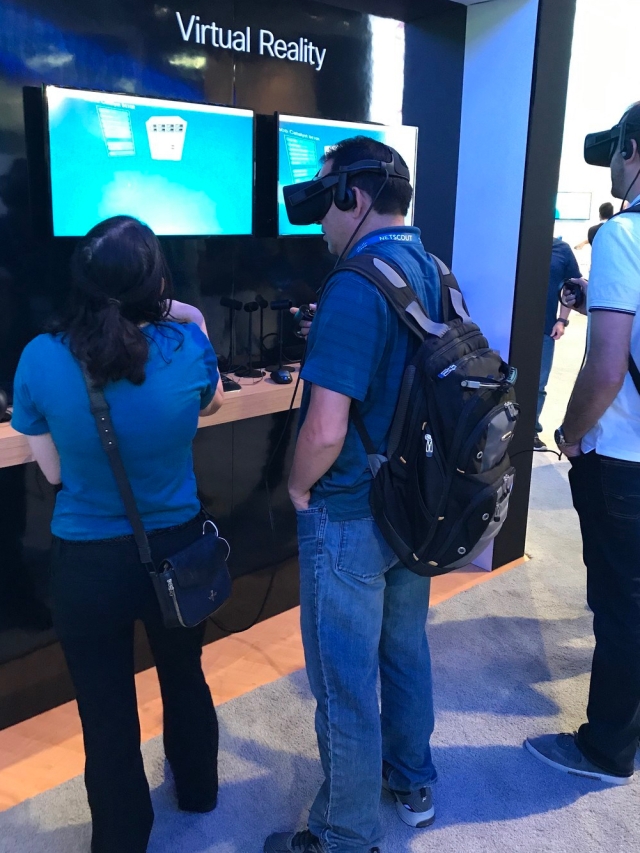
Ciena VR Data Center

Augmented and virtual reality allows products to be displayed within 3D environment.

There are a lot of ways technology can solve a problem – whether it’s in our everyday lives or in business. But, one unexpected fix that’s making waves in the enterprise is augmented reality (AR) and virtual reality (VR).

Piper Jaffray estimates that more than 500 million VR headsets could be sold by 2025. Many of those are likely to be used in business settings. From neuroscience to workplace training to industrial manufacturing, AR and VR are increasing the ease of use for enterprise applications across the globe.

Take Ciena, for example. Ciena is a global telecommunications networking, equipment, software and services supplier with a large partner network comprised of IT solutions providers.

The Challenge

Ciena’s sales teams were focused on selling a singular product and needed a way to show its partners its entire vertical landscape of solutions. In other words, they needed a tool that would help elevate conversations with their 400+ global partner companies and speed up the sales cycle.

The Solution

According to comScore, mobile devices dominate total minutes spent online across the globe (71 percent in the United States). And though Ciena sells to businesses, at the end of the day, we’re all consumers. So, Ciena looked to mobile as a means for evolving its selling methodology to become more solution-based.

Kaon Interactive helped Ciena develop an interactive marketing application that made it faster and easier for its sales teams to learn, share, and explore Ciena’s solutions like never before, from anywhere, anytime, on any device (including 3D augmented reality and WebVR). The SPEAR App allows sales teams, channel partners and marketers to demonstrate Ciena’s portfolio of products (in a data center, for example) at scale within a 3D virtual environment.
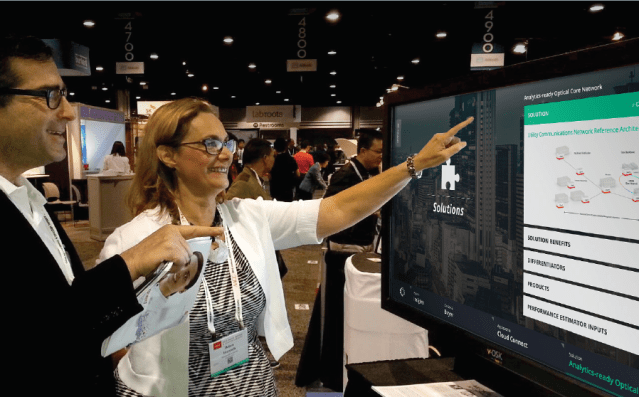
Ciena Interactive App Portfolio

SPEAR features industry insights, collateral, training videos, multi-language support and a virtual whiteboard function. Users can view and walk around products from any angle, take a photo with a product, and interact with it. This enables sales teams to customize the experience for their end-users so they can answer questions, collaborate, and close deals more quickly and effectively.

The Result

First launched in 2016, usage of the application doubled in just seven months. By the end of 2018, the hope is that the majority of Ciena’s global sales teams and engineers will use the application regularly to accelerate the sales process. Betsy Hansen, Ciena Director of Global Partner Communications, put it best: “The SPEAR App is a new way to do business.”

No matter your industry, it’s obvious that emerging technologies — whether it be AR/VR, robotics or predictive analytics — can have a measurable impact on the way business is conducted. From games to the office, we have a whole new world to which to look ahead.

Interested in learning how interactive marketing can help your organization accelerate the sales process? Contact us!

Posted in 3D Products, Channel Partners, Marketing Guru, Sales Tools | Tagged , , , , , | Leave a comment

Tech Insights from our CTO: Was Magic Leap’s AR Headset A Big Enough Leap?

Magic Leap Augmented Reality
Denny Luan

The much-anticipated Magic Leap One augmented reality headset finally made its (limited) retail debut almost two weeks ago today. With all of the buzz around this “leap” in AR technology, we have one question. What is the use case for our enterprise-level clients? And, was it enough of a leap?

While Magic Leap’s headset looks like a promising start, it seems pretty far away from being a viable platform for enterprise sales and marketing applications. The reported 40-degree field of view — which is the size of a credit card — is only marginally better than the Microsoft Hololens, and while a narrow field like that is useful in limited business cases like overlaying maintenance information, it prevents creating a fully immersive experience that will capture the imagination of customers and close deals.

The other concern we have is that Magic Leap glasses are fundamentally a personal device. Sixty-four percent of adults use glasses and will, therefore, need to have custom prescription inserts for the Magic Leap glasses to produce a clear picture. What that implies is that, practically speaking, the customer or prospect will need to have their own goggles. So, the platform has to be a success in the consumer space, on the scale of the mobile phone, before applications can be useful in most sales engagements. With an entry price point of $2,295, we have obvious concerns about widespread, consumer adoption.

The Magic Leap One AR headset was definitely a leap in the right direction, but a bigger leap is needed to impact the world of enterprise businesses.

Need a primer on the Magic Leap One AR headset? CNET published a concise but comprehensive overview.

What are you thoughts on the Magic Leap One? We would love to hear them in the comments below or on Twitter @marketing3D!

Joshua Smith headshot


Joshua Smith is the Founder and Chief Technology Officer of Kaon Interactive.

Posted in CEO Corner, Geek Talk, Hardware Trends | Tagged , , , , , | Leave a comment

Kaon Adds 11 Major Accounts to Its Enterprise Client Roster, Proving AR & VR Are Ready for B2B Marketing

Originally p

VR and AR Are Ready for The Enterprise

We are on the cusp of an immersive experience revolution. This revolution is already having a measurable impact on B2B enterprise sales and marketing, and the future will yield even more dramatic benefits as adoption grows.

Immersive experiences fuse real and digital worlds, allowing people to visualize and interact seamlessly with real and virtual objects and environments. (Augmented reality is the technology that “places” digital objects and data into a person’s view of the real world. Virtual reality is the technology that “places” a person into a digital environment. Mixed reality is the term that has come to mean the technology that uses some aspects of both augmented reality and virtual reality.]

Where are we in this revolution? First a “reality” check – while a lot of attention is focused on these technologies, it is clear that in both the B2B and B2C marketing and sales domains, neither AR nor VR will be used as a standalone experience. These techniques will be components of, or complements to a broader landscape of customer experience solutions. Almost every AR or VR experience will, in the long term, become a “feature” of how customers experience products and solutions when they are in the consideration (buying) phase and, to a large extent, in the implementation, deployment, and support part of a solution’s lifecycle.

This prediction is already being realized as more and more companies start to use AR and VR at relevant and meaningful stages of their customer lifecycle journeys. Yes, there remains much work to do to fully realize the potential of these technologies, but early adopters are already proving how much better their prospects and customers understand the value of complex products and solutions after engaging with these experiences.

Cisco Live Augmented Reality with Kaon AR

B2B sales and marketing teams have recognized what science has been teaching us for a while now, that the typical (slide) presentation is not effective in conveying the nuances of how a company’s complex solutions differ from, and are more valuable than competitive solutions. Leading global enterprises now understand that a broader set of sustained interactive customer experiences have become necessary. Because of the interactive and immersive nature of AR and VR, customers learn and remember more than twice as much as when they have listened to a sales presentation. As marketers and sales leaders shift away from presenting to customers towards delivering interactive experiences for customers, they are including AR and VR as components of this experience continuum.

3D Product Models in Virtual Reality with Kaon VR

This is not just theory, or academic speculation. My company, Kaon Interactive, has deployed interactive applications for 100 of the world’s most innovative global B2B enterprises, including augmented reality or virtual reality in almost every one of these applications. Innovators, such as Lenovo, Siemens Building Technology, Georgia Pacific, and many more have all asked Kaon to help develop and deploy customer-facing applications with AR and VR in sales meetings, trade shows, customer briefing centers, and even on the web.

What’s driving Kaon’s growth? Simply put, these experiences work. These applications, including AR and VR, have been proven to result in shorter sales cycles and reduced marketing expenses, because they are incredibly effective in helping prospects and customers understand the value of even the most complex solutions to their individual needs. The fact that the customer is actively engaged in navigating through the application themselves means that the most relevant message is being delivered to, and understood by each prospect in a distinctive, personalized way.

Both the software (ARKit and ARCore on standard mobile devices, for example) and the hardware (untethered VR headsets) for AR and VR are evolving rapidly, and these improvements are enabling even more use-cases for B2B sales and marketing. As with all technologies, these foundational improvements will create opportunities for companies to leverage these innovations in ways we can’t yet imagine. But we do know that the day will come (sooner than most expect) when AR and VR will be features and capabilities of most sales and marketing experiences, used naturally when and where they are appropriate and effective.

The revolution is already underway – experience it for yourself.


If you enjoyed this post, subscribe to our blog by entering your email on the right -> 

Posted in 3D Products, CEO Corner, Creative Crackerjack, Geek Talk, Marketing Guru, News, Sales Tools, Trade Show Trends | Tagged , , , , , , , , | Leave a comment